
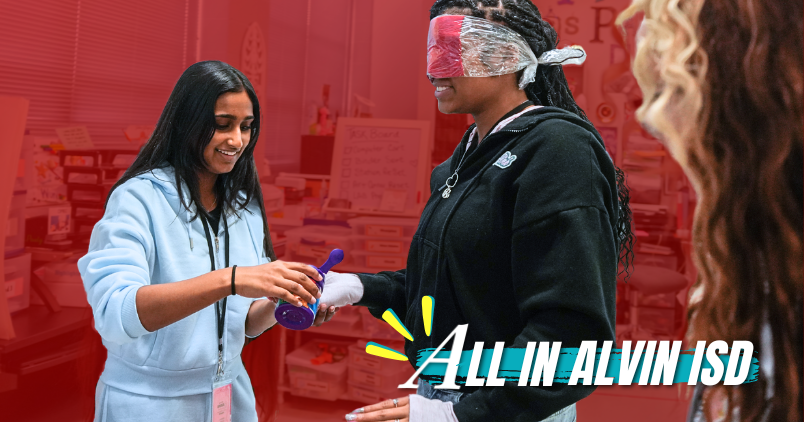
A recent lab in Ms. Pauly's Anatomy and Physiology class at Manvel High School put students knowledge of the brain and nervous system to the test by engaging all five senses.
To explore how the brain interprets sensory input, students rotated through a series of activities that challenged their senses of taste, touch, smell, sight, and hearing.
Each station required them to think beyond simply experiencing a sense and instead consider what signals their nervous system was sending to the brain and how the brain interpreted that information.
At one station, students tested their sense of taste with a round of the “BeanBoozled” jelly bean challenge, discovering firsthand how the brain processes flavors—sometimes pleasantly and sometimes… not so much.
While blindfolded, student had to taste a jelly bean and record what flavors their brain recorded simply on taste, while their partner recorded what the color of that jelly bean told them of what the flavor might be.
Another activity asked students to put their sense of touch to work. Blindfolded, they reached into containers filled with unknown objects and relied on texture and shape to determine what they were feeling without seeing it.
To test smell, students sampled scented markers without knowing the flavor beforehand and tried to identify each scent using only their noses.
Vision also came into play as students completed a simple eye test (both with and without glasses for those who use them) to understand how an eye exam determines someone's prescription and what that means for their vision health.
Another challenge focused on hearing and communication. One student described a picture their partner could not see, while the partner attempted to draw it based only on the verbal clues they heard, demonstrating how the brain interprets auditory information and translates it into understanding.
Through each activity, students connected the experience to what they’ve learned about the brain, discussing how inputs travel through the brain and how our brains convert those inputs into information.
By the end of the lab, students had a new appreciation for just how much work their brains do every second - particularly how quickly the brain can identify a taste or smell it doesn't like and react!